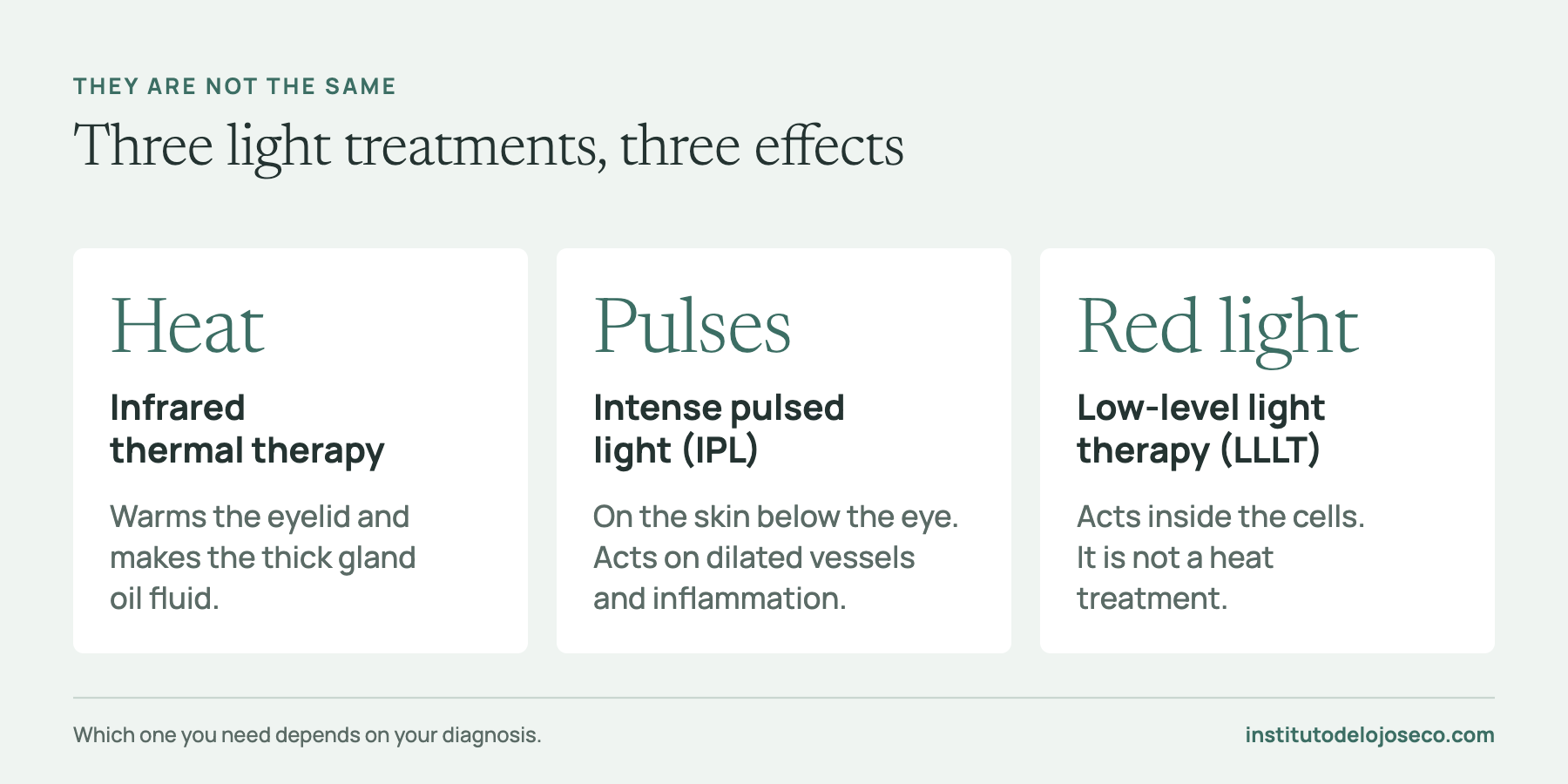
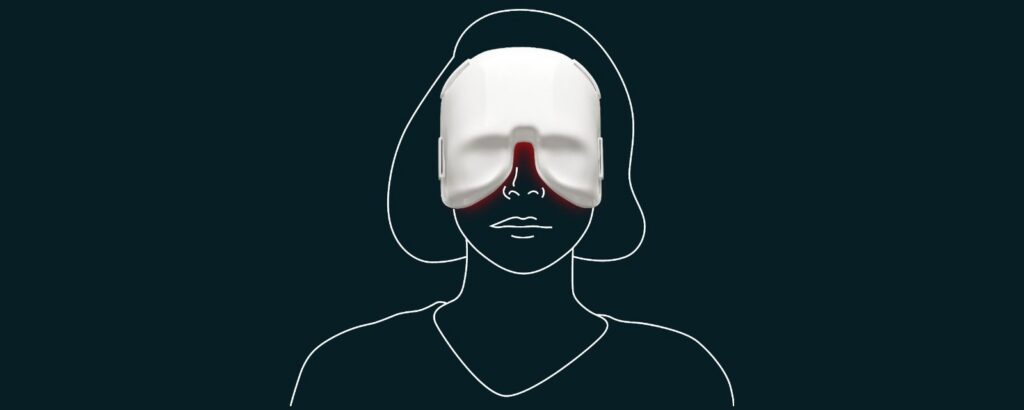
Low-level light therapy (LLLT), or photobiomodulation, is a mask of gentle red light placed over your closed eyelids for 10 to 17 minutes, depending on the device. It is not a heat treatment and does not hurt. It is used as a complement to calm inflammation of the eyelid margin; on its own it does not unblock a clogged gland.
What is light therapy for?
It is a complement, not a main treatment. It is added to the plan when there is inflammation in the eyelids or in the meibomian glands: blepharitis, irritated eyelid margins, and glands that become inflamed again and again. In small series with no comparison group it has been used for chalazia (firm little lumps in the eyelid) that would not go away; that evidence is preliminary.
What it does not do: empty a blocked gland. For that, heat and expression remain decisive.
Mechanism
How low-level light works
Red and near-infrared light pass through the thin skin of the eyelid and are absorbed inside the cells, in the mitochondria, which are their power plants. That effect is called photobiomodulation: the light does not heat the tissue, but it can influence how cells produce energy and how they respond to inflammation.
How much effect it has depends on the wavelength, the dose, and the time. That is why each device has its own protocol, and results vary from person to person.
Some systems also include blue light; its usefulness in blepharitis or Demodex has not yet been demonstrated.
It is not a heat treatment. You may notice that your skin feels warm, but light therapy does not soften the thick oil in the glands the way infrared thermotherapy does.
The session
What a session is like
- 01
Before
We check which medications you take (some make the skin sensitive to light) and the condition of your eyes and your skin.
- 02
During
You lie back with your eyes closed and the mask or light panel is put in place. It is painless and usually feels pleasant. No anesthesia or gel is needed.
- 03
After
You go back to your activities right away. You can drive and work at a screen.
- 04
The course
The number of sessions and the time between them change from one device to another and according to your diagnosis. We explain it with your plan.
Who it is for
Who it is for
- Red, inflamed eyelid margins.
- Blepharitis.
- Meibomian glands that become inflamed again and again, as a complement to other treatments.
- Chalazia that do not go away, as a complement.
When it isn’t suitable or has limits
- If the problem is a blocked gland, light therapy alone is not enough.
- It is not used, or is weighed very carefully, if you take medications that make the skin sensitive to light, if you have light-sensitive epilepsy, or if you have an active tumor in the area.
- During pregnancy and breastfeeding, it is decided case by case.
The devices
There are masks designed for the eyelids and LED panels for general medical use that are also applied to the face with the eyes closed:
Eye-Light (LM LLLT)
Espansione Group · ItalyAn LED mask that rests on the closed eyelids; the same device includes IPL. It is CE-marked as a class IIa medical device.
Healite II
Lutronic · South KoreaA panel of yellow and near-infrared LEDs that covers the whole face. It originated in dermatology.
Celluma
BioPhotas · USAA flexible panel of blue, red, and near-infrared LEDs. Its U.S. clearances are for the skin and for muscle and joint pain.
We mention them so you know which technologies exist. We have no commercial relationship with these manufacturers, and naming them does not indicate which one we use: the wavelength and the protocol are chosen according to your diagnosis.
We see you in the office, at the Instituto del Ojo Seco: Dante 6, Colonia Anzures, Mexico City. How to prepare and what to do afterward: Your treatment session.
Book your assessment
We examine your eyelids and your glands to find out whether light therapy can complement your treatment.
Common questions
Frequently asked questions
How well studied is light therapy for dry eye?
It is the newest of the therapies we offer and the one with the fewest studies. The existing ones, most of them small, show improvement in symptoms and in gland function, but large trials are lacking. That is why we use it as a complement and not as a main treatment.
Why is it combined with other treatments?
Because it acts on inflammation, not on blockage. Hardened oil and closed openings need heat, cleaning, or expression.
Do you feel warmth?
Sometimes, a slight warmth on the skin. It is not equivalent to heat treatment of the glands.
When is the effect noticeable?
It varies from person to person. It is usually assessed at the end of the course, not after the first session.
How much does it cost?
It depends on the number of sessions and on the therapies it is combined with. We explain it after the assessment, before you start.
Sources
From the blog