Punctal plugs are very small plugs made of silicone or of a material that dissolves on its own. They are placed in the two tiny drainage openings (puncta) at the inner corner of the eye, where tears drain, and they hold the tears back. That way, your own tears stay on the eye longer. Placing them takes a few minutes and requires no injection.
What are punctal plugs for?
They are used above all when tears are lacking (aqueous-deficient dry eye): the lacrimal gland produces too few, for example in Sjögren’s syndrome or another autoimmune disease, with age, or because of certain medications. The eye is poorly lubricated, and burning, a gritty feeling, redness, discomfort in bright light, and vision that comes and goes appear.
At the assessment, the signs that point to it are a low tear meniscus, that is, few tears pooled along the eyelid margin, and the dry areas that the dye marks on the surface of the eye. If that is your case, it makes sense to help the tears you produce stay longer.
Plugs do not increase tear production. They also do not treat inflammation or clogged meibomian glands. They complement treatment of the cause; they do not replace it.
Mechanism
How they work
Tears are produced all the time, spread over the eye with every blink, and drain at the inner corner. There, on the margin of each eyelid, is a tiny opening: the punctum. Through it, tears pass into small ducts that carry them to the nose. That is why your nose runs when you cry.
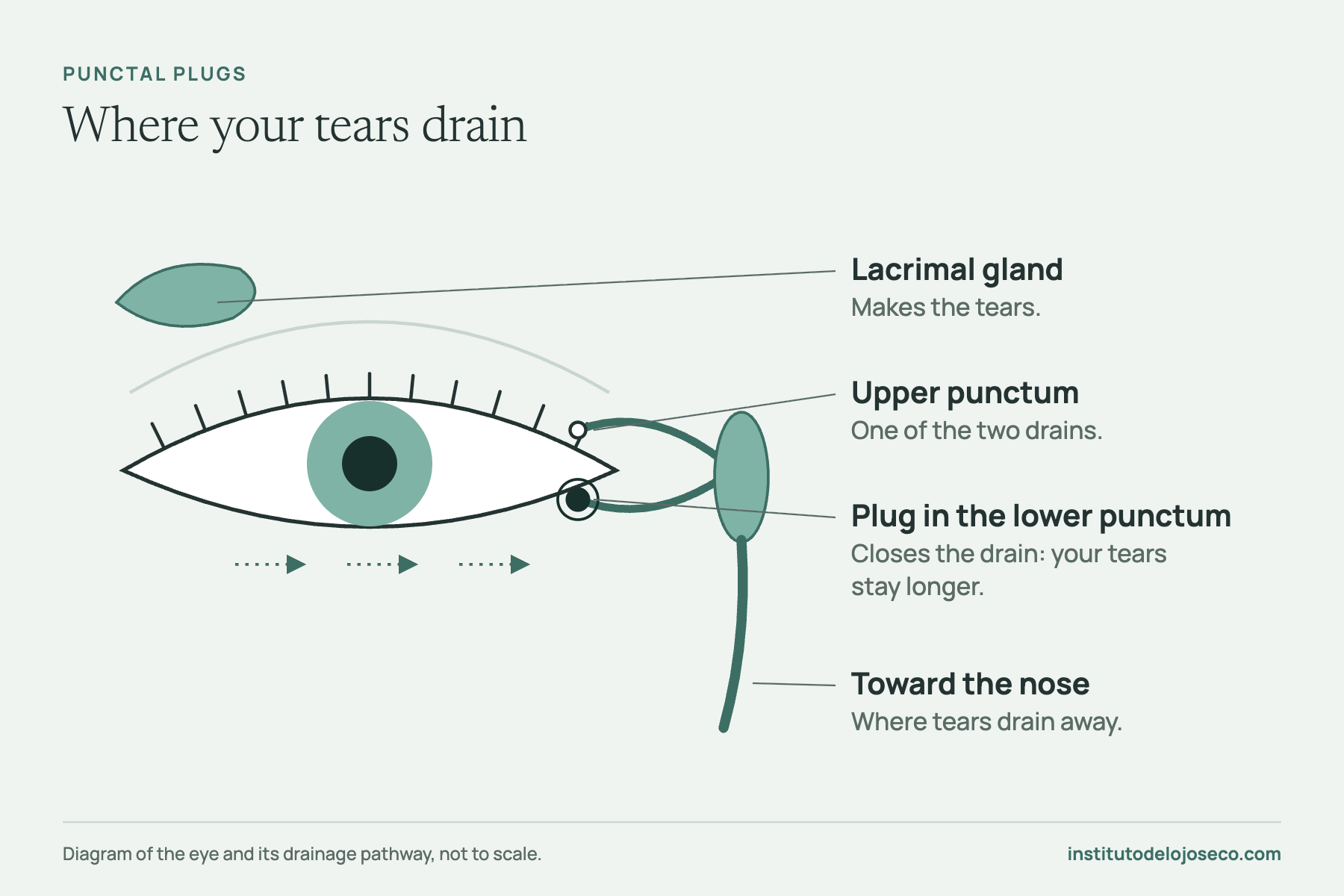
A plug closes the punctum. Fewer tears drain away, and the ones you have last longer. Eye drops also stay in the eye longer: if you use medicated eye drops, the dose may need to be adjusted, and preservative-free drops are the better choice.
First, the inflammation. Tears also wash away the substances that inflame the eye. If the drainage is closed while the inflammation is active, those substances stay longer. That is why the eyelids, the meibomian glands, and the surface of the eye are treated first.
The session
What placement is like
- 01
Before
We measure how many tears you have and check the surface of the eye and the eyelids, to confirm that tears are lacking and that closing the drainage makes sense. Then the punctum is measured to choose the size. Often a dissolvable plug is placed first, to test the effect.
- 02
During
If needed, a drop of anesthetic is put in. The doctor places the plug with a fine applicator. It takes a few moments per eye, and you feel brief pressure. Often the lower punctum is closed first, in both eyes during the same session.
- 03
After
You go back to your activities right away. For the first few days you may feel that there is something at the inner corner of the eye. Do not rub that area, so the plug does not come out. Call us if you have tearing that does not let up, pain, increasing redness, swelling, or discharge.
- 04
Follow-up
At the follow-up visit we check that the plug is still in place and whether your symptoms and your measurements have improved. A plug can fall out without your noticing; if needed, it is replaced, sometimes with a different size. If closing the lower punctum is not enough, the upper one can be closed as well.
Who they are for
Who they are for
- A confirmed lack of tears, for example from Sjögren’s syndrome.
- Symptoms or damage on the surface of the eye that persist despite eye drops and basic care.
- People who wear contact lenses and have a confirmed lack of tears.
When they aren’t suitable or have limits
- They are not placed with an active infection of the eye or the tear drainage system, if the tear drainage system is blocked, if the lower eyelid turns outward (ectropion), or if you are allergic to the material.
- If the eyelids or the surface of the eye are inflamed, that is treated first.
- If your tears evaporate but you do not lack them, plugs are not the main treatment: the eyelids and the glands are treated first.
The plug types
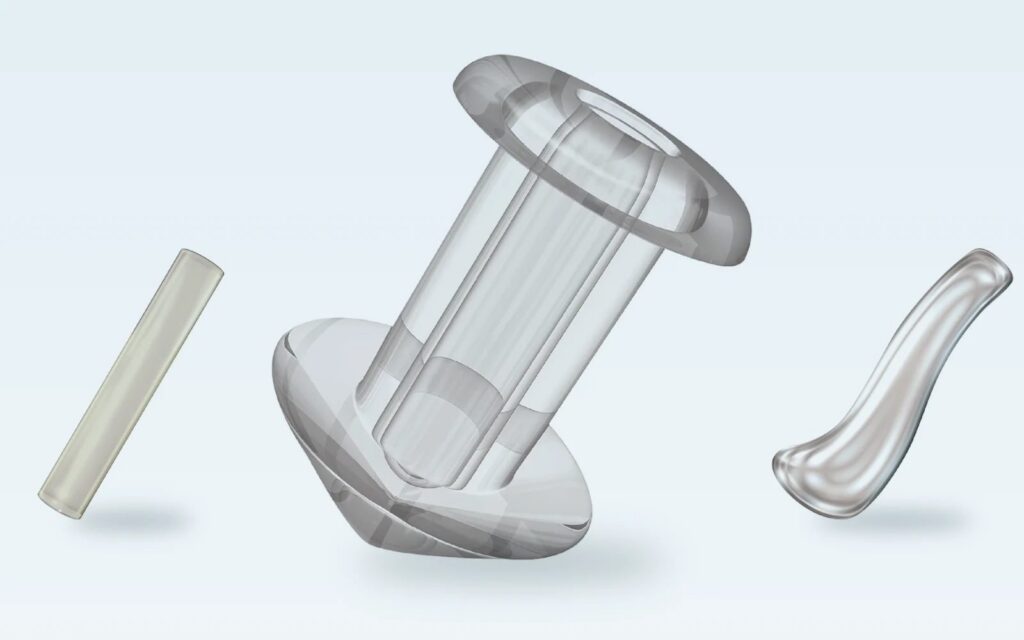
There are three types. We name one manufacturer of each as an example:
Silicone plug
FCI · FranceSits visibly in the punctum, with a small rim. It can last for years and, if needed, is easy to remove.
Dissolvable plug
Oasis Medical · USAMade of collagen or synthetic materials; it dissolves on its own in days or months, depending on the product. It is used to test the effect first.
Intracanalicular plug
Oasis Medical · USAPlaced deeper, in the duct, and not visible from the outside. It is harder to check and to remove, and in rare cases it can inflame the duct months or years later.
We have no commercial relationship with these manufacturers, and naming them does not indicate which one we use: the type and size of the plug are chosen according to your diagnosis and the size of your punctum.
Book your assessment
We measure how many tears you have and how long they last, to find out whether you lack tears or they evaporate, and whether plugs make sense.
We see you in the office, at the Instituto del Ojo Seco: Dante 6, Col. Anzures, Mexico City. How to prepare and what to do afterward: Your treatment session.
Common questions
Frequently asked questions
Does it hurt to have punctal plugs placed?
Usually you feel only brief pressure at the inner corner of the eye. If needed, a drop of anesthetic is put in beforehand. No injection is needed.
How long do punctal plugs last?
Dissolvable plugs last from a few days to several months, depending on the material. Silicone plugs can stay in place for years, as long as they do not fall out and are not removed.
Will I notice the plug in everyday life?
For the first few days you may feel that there is something at the corner of the eye; this usually passes. After that, most people no longer notice it. If it bothers you, it is removed or exchanged for a different size or a different type.
Can the plug be removed?
Silicone plugs are removed in a few moments with fine forceps. Dissolvable plugs dissolve on their own. Intracanalicular plugs are harder to reach: removing them requires flushing the tear drainage system and, in rare cases, a minor procedure.
What happens if a plug falls out?
It is the most common problem with silicone plugs and usually has no consequences. If the symptoms come back, another one is placed at a follow-up visit, sometimes in a different size.
My eyes water. Can plugs help me?
It depends on why they water: if the underlying problem is a lack of tears, plugs can help; if oil is lacking, the eyelids are treated; if the drainage is blocked or the lower eyelid does not rest properly against the eye, plugs make no sense. The exam clarifies the cause, and we explain it in Why do my eyes water if they are dry?.
Can the eye water after placement?
Yes. In some people, more tears are left than the eye can drain. That is why only the lower punctum is usually closed first, with a dissolvable plug as a trial. If the eye waters persistently, the plug is removed.
When is the improvement noticeable?
It can be noticed within days or a few weeks. How much it improves varies from person to person; that is why a dissolvable plug is tried first.
How much does it cost?
It depends on the type of plug and on how many puncta are closed. We explain it after the assessment, before you start.
How well studied is the treatment?
Closing the puncta has been done for decades and is listed in international dry eye recommendations. Observational studies show improvement in well-selected patients, but high-quality trials are few, and a 2017 Cochrane review considered their results inconclusive. That is why careful selection and the trial with a dissolvable plug matter so much.
Sources
From the blog