Meibomian gland expression is the in-office procedure that unblocks the glands that produce the oil of your tears. First they are warmed, to soften the trapped oil; then the eyelid is pressed, section by section, so the oil comes out through the glands’ natural openings. It takes about 5 minutes and feels like brief, intense pressure.
What is gland expression for?
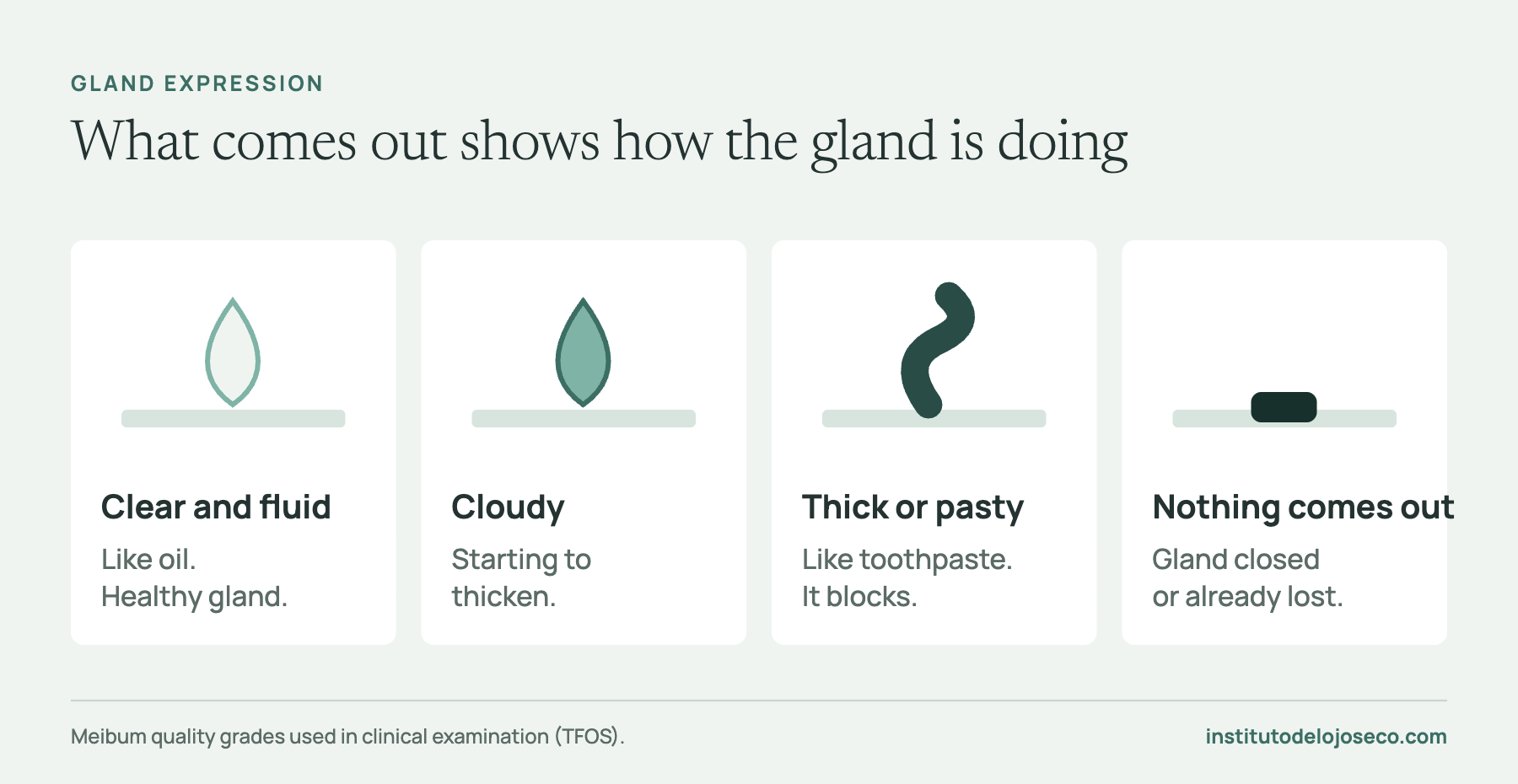
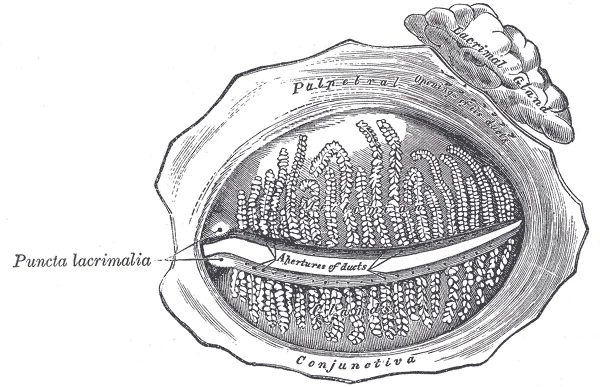
The meibomian glands produce the oil that protects your tears from evaporating. When that oil thickens, it stops coming out with each blink and builds up inside the gland. This is meibomian gland dysfunction (MGD), the most common cause of dry eye.
A gland that stays blocked for a long time does not just stop supplying oil: it gradually becomes damaged and can be lost. Emptying it in time is meant to get it working again.
Mechanism
Why a blocked gland does not empty on its own
For the oil to come out, two things are needed: it has to be fluid enough, and the opening has to be clear. In a healthy gland, the slight pressure of each blink is enough.
In MGD, both fail. The oil becomes thick, and the opening narrows with deposits and hardened skin. Blinking is no longer enough to get it out.
That is why the treatment has two steps. Heat restores the flow; controlled pressure does what blinking no longer can.
The session
What an expression is like
- 01
Before
We examine your eyelids and your glands with meibography. Then the eyelids are warmed in a controlled way, for example with infrared thermotherapy. If needed, anesthetic eye drops are applied.
- 02
During
The doctor holds the eyelid from the inside and the outside with an instrument designed for the purpose and presses it section by section. You feel intense pressure that lasts a few seconds on each section. Meanwhile, the doctor observes the amount, color, and consistency of what comes out.
- 03
After
The eyelid margins are cleaned. They may stay somewhat red or tender for a while. Your vision may be a little blurry for a few minutes. You usually need no recovery time.
- 04
The course
How often it should be repeated depends on how blocked your glands are and on how they respond. It can be done after infrared thermotherapy or after IPL, which also warms the eyelids.
Who it is for
Who it is for
- You have been told you have blocked glands or meibomian gland dysfunction.
- Your tears evaporate fast and the assessment shows thick or cloudy oil.
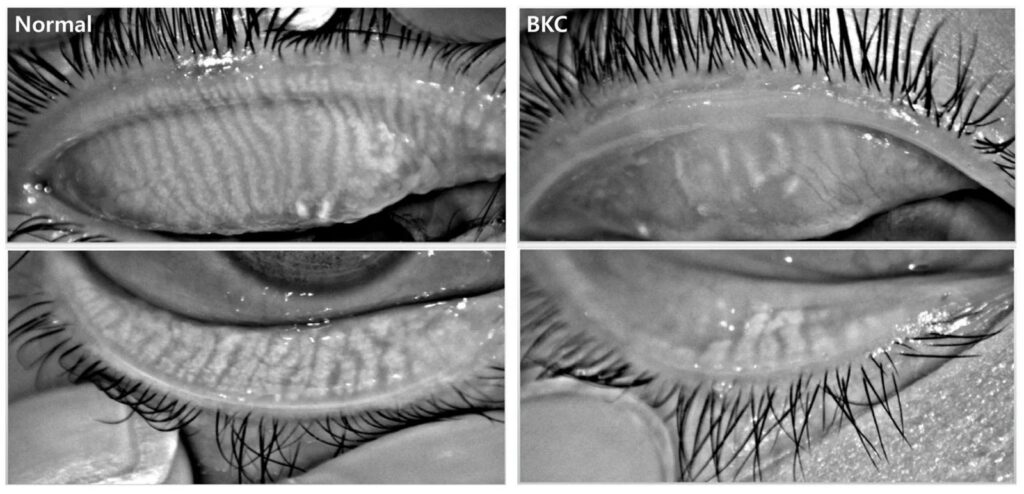
- Meibography shows that you still have glands.
- Heat alone has not been enough.
When it isn’t suitable or has limits
- It is postponed if there is an acute infection or inflammation of the eyelid, a recent stye, herpes in the area, or recent eye surgery.
- If you take blood thinners or bleed easily, let us know: it is weighed with particular care.
- If you lack tears but your glands work well, it is not the main treatment.
- When gland loss is advanced and nothing comes out anymore, what can be achieved is limited.
The instruments
Expression is done by hand, with instruments designed for the purpose. Two examples of different designs:
Arita Meibomian Gland Compressor
Katena · USAForceps with broad, polished tips that are placed parallel to the eyelid margin and compress the glands section by section.
MG Expressor Kit
Gulden Ophthalmics · USAA plate is placed behind the eyelid and a small roller presses from the outside.
We mention them so you know which instruments exist. We have no commercial relationship with these manufacturers, and naming them does not indicate which one we use: the instrument and the pressure are chosen according to your diagnosis.
We see you in the office, at the Instituto del Ojo Seco: Dante 6, Colonia Anzures, Mexico City. How to prepare and what to do afterward: Your treatment session.
Book your assessment
With meibography we see how much gland tissue you still have and whether expression can help you.
Common questions
Frequently asked questions
Does gland expression hurt?
It is the most intense step of the treatment: strong pressure that lasts a few seconds on each section of the eyelid. With good warming beforehand it is easier to tolerate, and anesthetic eye drops are used if needed.
Can I squeeze my glands myself?
Pressing hard with your fingers or with tools is not advisable. Professional expression is done while viewing the eyelid margin under magnification, with controlled pressure and with instruments designed for the purpose. At home, what does help is heat done well.
Can shortened glands grow back?
As far as is known today, what has been completely lost does not recover. But a shortened gland can still work: what counts is how much functional tissue is left, and that tissue can be treated.
How often does it need to be repeated?
There is no schedule that works for everyone. It depends on the condition of your glands, the quality of the oil, your symptoms, and how the previous session went for you.
How much does it cost?
It depends on the therapies it is combined with. We explain it after the assessment, before you start.
Sources
- Jones L, Craig JP, Markoulli M et al., TFOS DEWS III: Management and Therapy. American Journal of Ophthalmology, 2025. PubMed
- Geerling G, Tauber J, Baudouin C et al., The international workshop on meibomian gland dysfunction: report of the subcommittee on management and treatment. Investigative Ophthalmology & Visual Science, 2011. PubMed
From the blog
- Infrared thermotherapyThe heat that prepares for expression→
- Eyelid cleaningRemoving the crusts and the layer of bacteria from the eyelid margin→
- Intense pulsed light (IPL)Light for inflamed eyelids and ocular rosacea→
- Low-level light therapy (LLLT)Red light as a complement→
- All treatmentsCompared at a glance→