If your eyes feel drier, burning, or gritty in Mexico City, you are not imagining it. Three things come together here that make tears evaporate faster: the altitude, the low-humidity air of the dry season, and air pollution, especially ozone. You cannot change any of them, but you can protect your eyes from all three.
In brief. Tears evaporate faster when the air is dry, and the city’s air is dry: because of the altitude all year and, on top of that, from November to April, when it hardly rains.
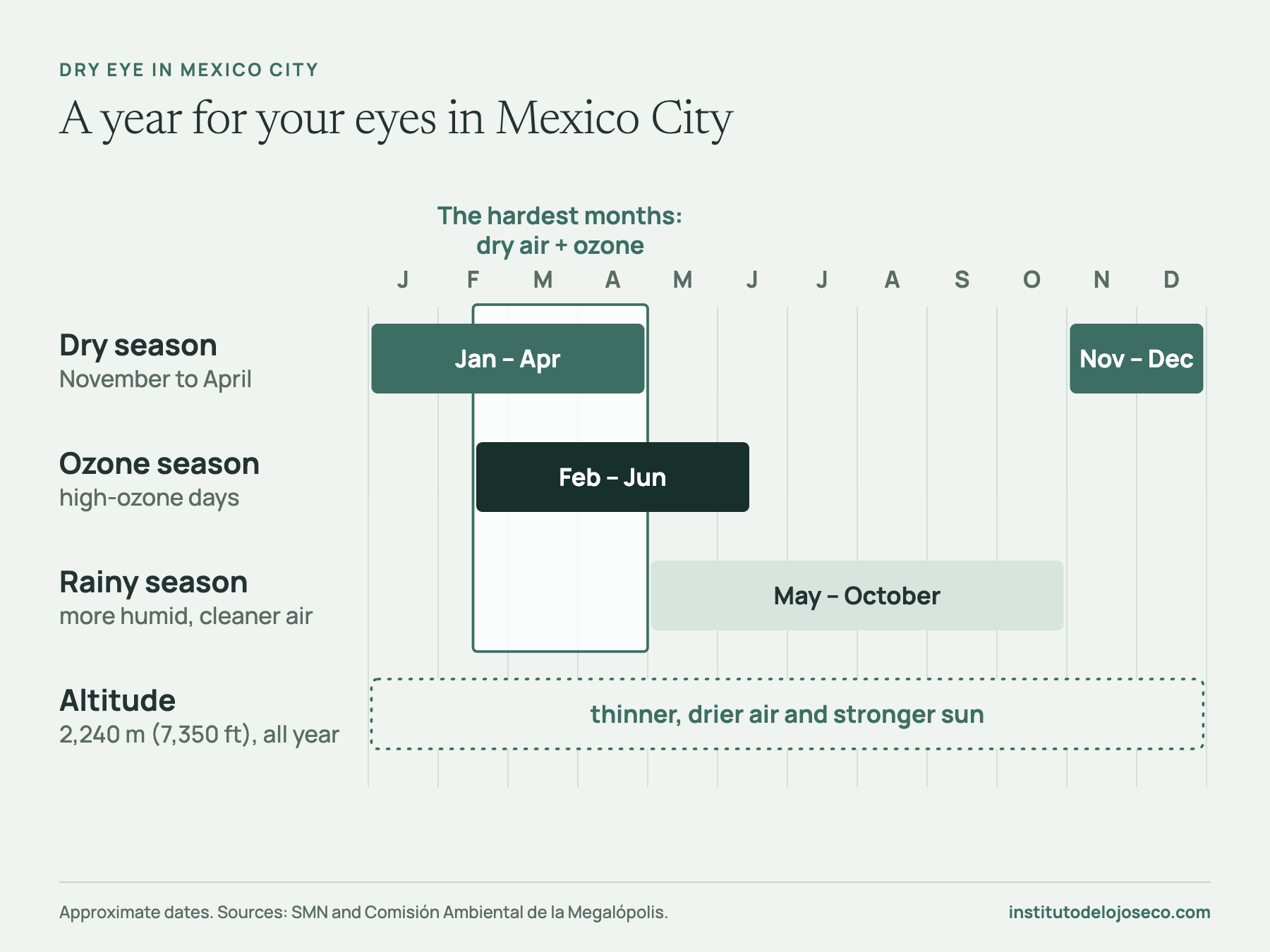
From mid-February through April, dry air and ozone season overlap. These tend to be the hardest months for your eyes.
Less dry indoor air, wraparound sunglasses, screen breaks, and preservative-free artificial tears help. If the discomfort lasts for weeks, it is worth having your tears measured.
Why altitude dries out your eyes
Mexico City sits at about 2,240 meters (7,350 feet) above sea level. At that height the air is thinner and almost always holds less water vapor than on the coast.
Your tear film is only a few thousandths of a millimeter thick: when the air around it is dry, the water in that layer passes into the air more easily and the tear film breaks up before your next blink. Each spot where it breaks is a spot of the eye’s surface left unprotected, and that is what you feel as burning or grittiness.
The sun adds to the altitude: ultraviolet radiation is stronger the higher you are, and the surface of your eye receives it too.
Some studies compare people living at high altitude with others at low altitude. In one from India, dry eye was diagnosed in 20% of the people assessed at 3,300 meters and in 9% of those assessed at 218 meters. Mexico City is not that high, but the mechanism is the same: drier air, more evaporation.
The dry season: November to April
From May to October it rains almost daily and the air carries moisture. The rest of the year, from November to April, it hardly rains and the air dries out. On cold mornings many people also turn on a space heater, which lowers the humidity in the room even more.
The effect of dry air on tears has been measured. In an experiment with healthy people, one hour in a very low-humidity environment was enough for tears to evaporate faster, for the protective oily layer to thin, and for the tear film to break up sooner. By the end of that hour, their measurements looked like those of patients with dry eye.
Could it be dry eye? Take the dry eye test: 12 questions, 3 minutes, free, with no sign-up. Take the test Or see what the advanced diagnostics at the institute involve.
Do pollution and ozone dry out your eyes?
Ozone does not come straight out of exhaust pipes: it forms when gases from vehicles and industry react with strong sunlight. That is why environmental authorities talk about an ozone season, which runs roughly from mid-February to mid-June: there is plenty of sun, little wind, and the rains have not arrived yet. This is when most air-quality alerts (contingencias ambientales) are declared.
Ozone is an oxidant. On contact with tears and with the cells on the surface of the eye, it causes oxidative stress and inflammation, and an inflamed surface holds tears less well. In a study of more than 16,000 people in South Korea, those living in areas with more ozone and lower humidity had more dry eye symptoms and more dry eye diagnoses.
We do not know of an equivalent study carried out in Mexico City, so the honest way to put it is that the effect here is likely, not proven.
How common is dry eye in Mexico?
Two Mexican studies give a sense of the size of the problem. In a population survey in Tlaxcala, 41% of adults aged 50 or older had dry eye symptoms. And in an eye hospital in Mexico City, an examination of 338 new patients found signs of excessive tear evaporation in 94%, while a lack of tear production appeared in 22%.
That finding matters for treatment. In most cases the problem is not a lack of water but that tears evaporate. And the layer that slows evaporation is the oily one produced by the meibomian glands, in the eyelid margin.
How to protect your eyes in Mexico City
At home and at work
- Add moisture to the air. A humidifier in the bedroom or next to your desk during the dry season may help the air take less water from your tears.
- Redirect airflow. Fans, space heaters, and car air vents dry your eyes more when they point at your face. Aim them elsewhere.
- Lower your screen. When you look down, your eyelid covers more of the eye and less surface is exposed to the air. Place your monitor slightly below eye level and take breaks: you blink less in front of a screen.
Outdoors
- Wear wraparound sunglasses. They cut the wind, which speeds up evaporation, and filter ultraviolet radiation.
- Check the air quality. The city’s index is published every hour at aire.cdmx.gob.mx (the city’s air-quality site, in Spanish). On alert days, authorities recommend avoiding outdoor exercise in the afternoon, when ozone peaks. Your eyes benefit too.
- Do not rub your eyes. If you feel dust or burning, rinse with artificial tears instead of rubbing.
- If you wear contact lenses, consider switching to your glasses on poor air-quality days.
With eye drops
Artificial tears replace, for a while, what the air takes away. If you use them more than four times a day, choose preservative-free ones. Avoid “get the red out” drops as a daily solution: they constrict blood vessels, but they do not lubricate. In another article we explain how to choose eye drops for dry eye.
Drops bring relief, but they do not correct the cause when tears evaporate because they lack oil. For that, the eyelids need to be examined.
If you have just arrived in the city
If you come from a city at sea level, you may notice drier eyes from the first days, especially between November and April. The same measures apply, and it is a good idea to bring the artificial tears you already know. If you wear contact lenses, you may tolerate them for fewer hours here.
When an assessment is worthwhile
If burning, grittiness, watering, or vision that blurs and clears when you blink last more than a few weeks, or if you need drops several times a day to feel comfortable, it is worth measuring what is happening to your tears. That is what advanced diagnostics do, and their results are the basis for deciding which treatment makes sense in your case.
Severe pain, loss of vision, a very red eye, or strong discomfort with light are not typical dry eye symptoms: go to an eye emergency service.
Do your eyes dry out more in this city?
An assessment measures your tears and your glands, and tells you how much of the problem is the environment and how much can be treated.
Frequently asked questions
Does dry eye get worse during ozone season?
It is likely. Ozone irritates and inflames the surface of the eye, and ozone season starts while the air is still dry. In studies from other countries, living with more ozone is associated with more dry eye symptoms.
Why do my eyes water on air-quality alert days?
When the surface of the eye is irritated, the corneal nerves send a signal and the lacrimal gland responds with emergency tears, which are very watery. Those tears overflow, but they do not lubricate well: that is why your eyes can be watery and dry at the same time.
Does a humidifier help with dry eye?
It may help, especially in the bedroom and from November to April. It does not replace treatment when the problem is in the eyelid glands, but it reduces what the air takes from your tears.
Does dry eye go away in the rainy season?
Many people feel better with more humid air, but if the cause is in your eyelids or your tears, the problem is still there. Screens, air conditioning, and contact lenses dry your eyes all year.
Sources
- Alves M, Asbell P, Dogru M et al., TFOS Lifestyle Report: Impact of environmental conditions on the ocular surface. The Ocular Surface, 2023. PubMed
- Hwang SH, Choi YH, Paik HJ et al., Potential importance of ozone in the association between outdoor air pollution and dry eye disease in South Korea. JAMA Ophthalmology, 2016. PubMed
- Abusharha AA, Pearce EI, The effect of low humidity on the human tear film. Cornea, 2013. PubMed
- Gupta N, Prasad I, Himashree G et al., Prevalence of dry eye at high altitude: a case controlled comparative study. High Altitude Medicine & Biology, 2008. PubMed
- Martinez JD, Galor A, Ramos-Betancourt N et al., Frequency and risk factors associated with dry eye in patients attending a tertiary care ophthalmology center in Mexico City. Clinical Ophthalmology, 2016. PubMed
- Graue-Hernández EO, Serna-Ojeda JC, Estrada-Reyes C et al., Dry eye symptoms and associated risk factors among adults aged 50 or more years in Central Mexico. Salud Pública de México, 2018. PubMed
- Tsubota K, Nakamori K, Effects of ocular surface area and blink rate on tear dynamics. Archives of Ophthalmology, 1995. PubMed
- Comisión Ambiental de la Megalópolis, ozone season and air-quality alerts. gob.mx/comisionambiental
- Servicio Meteorológico Nacional, rainy season. smn.conagua.gob.mx
- Advanced diagnosticsWhat is measured in a dry eye assessment→
- TreatmentsThe institute’s options, one by one→
- Meibomian glandsThe most common cause of dry eye→
This article is general information and does not replace a medical consultation. The results of any treatment vary from person to person.