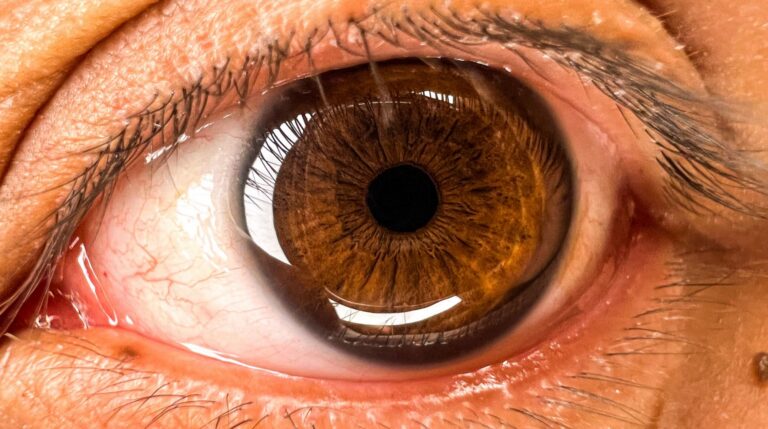
Almost everyone with dry eye starts with drops, and that is fine: artificial tears are the first step. The hard part is choosing in front of a shelf full of similar boxes. There are three decisions: that they are lubricating drops and not “get the red out” drops, that they have no preservatives if you use them often, and that they contain lipids if your tears evaporate.
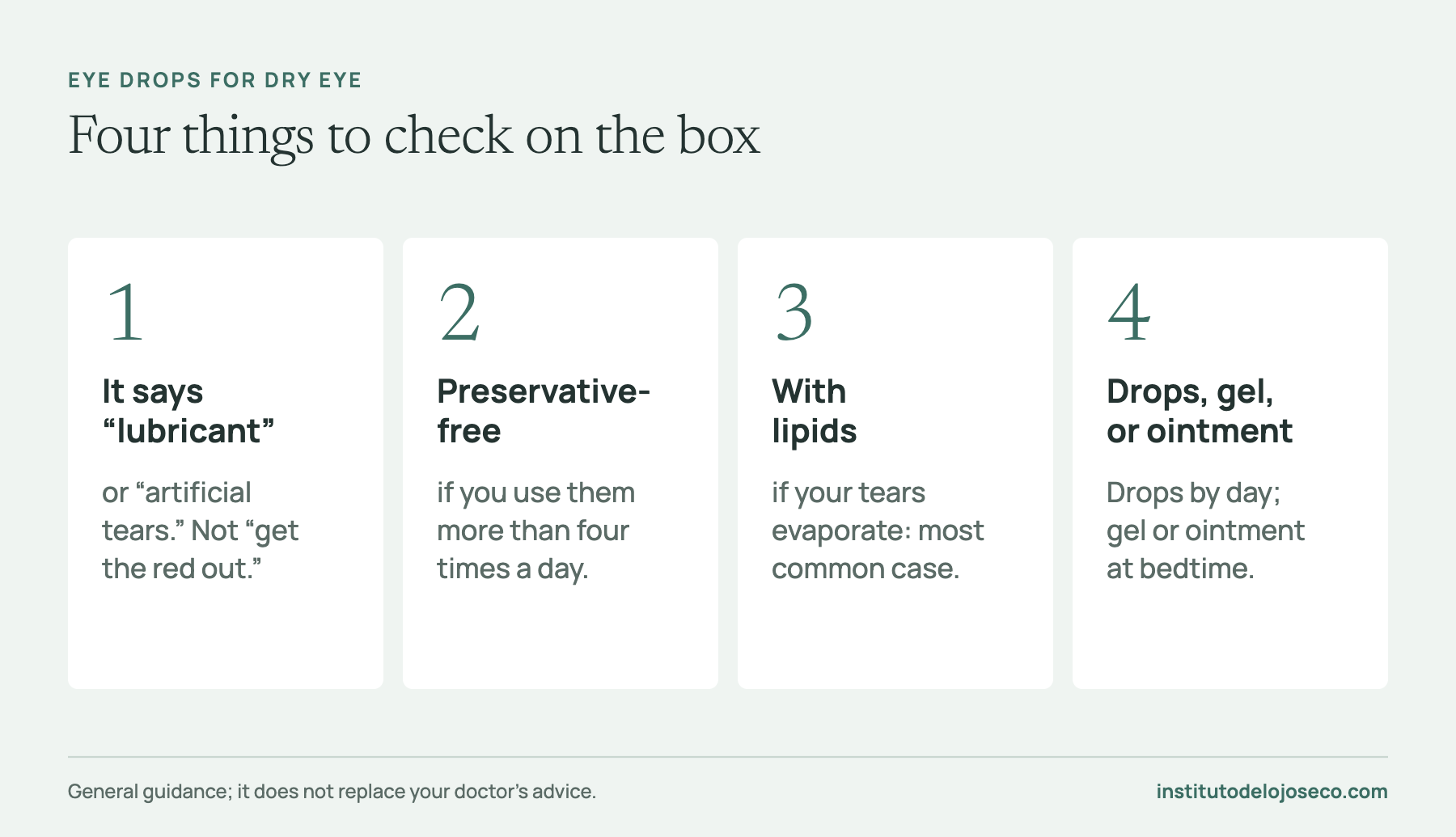
In brief. Look for the words “lubricant” or “artificial tears” on the box. For daily use, avoid drops that promise to get the red out.
If you use them more than four times a day, choose preservative-free ones.
Use them regularly for a month before deciding whether they help you. If after that month you feel the same, the problem is probably not one that drops resolve.
Which eye drops help dry eye and which do not?
The same shelf holds very different drops. The ones that help you say “lubricant eye drops” or “artificial tears.” They replace, for a while, the water in your tears, and some also replace the oil.
“Get the red out” drops are something else. They contain vasoconstrictors (in the ingredient list they appear as naphazoline, tetrahydrozoline, oxymetazoline, or phenylephrine), which narrow the blood vessels on the surface of the eye. The eye looks white for a few hours, but it is not lubricated, and with daily use the redness returns and can become chronic.
In a series of 70 patients with conjunctivitis caused by these drops, half had been using them daily for three years or more; after stopping them, half improved in about four weeks. If you have angle-closure glaucoma or have been told you have narrow angles, do not use them.
Do not use antibiotic or steroid (cortisone) drops on your own either. Steroid drops can raise the pressure in the eye, and that is something you do not feel. Only with a prescription and monitoring.
Eye drops with or without preservatives?
Multi-dose bottles contain preservatives so that they do not become contaminated once opened. The most common one is benzalkonium chloride. A few drops a day are usually well tolerated, but with frequent use that preservative damages the cells on the surface of the eye and can worsen the very thing you want to relieve.
The rule of thumb: if you need drops more than four times a day, choose preservative-free ones. They come in single-dose vials or in bottles with a filter in the tip; the box says “preservative-free” or “no preservatives.”
Could it be dry eye? Take the dry eye test: 12 questions, 3 minutes, free, with no sign-up. Take the test Or see what the advanced diagnostics at the institute involve.
With or without lipids
Most cases of dry eye are not due to a lack of water, but to tears that evaporate because they lack their oily layer. For those cases there are artificial tears with lipids; they usually look milky, and the box mentions “lipids,” “emulsion,” or “lipid layer.”
In a six-month trial that compared drops with and without lipids, both relieved symptoms. In those who had a deficient oily layer, only the drops with lipids improved that layer.
Since you cannot tell by looking what your tears are missing, if water-based drops are not enough for you, it is worth trying drops with lipids, or having your tears measured.
Drops, gel, or ointment
| Form | What it is like | When it is a good choice |
|---|---|---|
| Drops | Liquid; they hardly blur your vision | During the day, as often as needed |
| Gel | Thicker; lasts longer and blurs your vision for a few minutes | More pronounced discomfort; before going to sleep |
| Ointment | Greasy; blurs your vision quite a bit | Only at bedtime, if you wake up with dry eyes |
How long do artificial tears take to work?
Drops are not judged by what you feel on the first day. The international TFOS DEWS III consensus recommends using them consistently, about four times a day, for close to a month before deciding whether they help you. In the six-month trial, symptoms improved from the first month on, and the measurements of the surface of the eye not until the fourth.
If there is no change after a month, switching formulas is normal: according to the same consensus, about one in four people does not respond to a given artificial tear. A Cochrane review of 43 trials found almost no consistent difference between brands or ingredients.

How to put them in
- 01Wash your hands.
- 02Tilt your head back and pull down your lower eyelid with one finger.
- 03Let one drop fall into the pocket that forms, without the tip touching your eye, your eyelashes, or your fingers.
- 04Close your eye gently for half a minute. One drop is enough: the eye does not hold more.
- 05If you use other drops, wait five minutes between one kind and the next.
If you wear contact lenses, check that the box says the drops are compatible with them.
Single-dose vials are thrown away after use, even if there is liquid left: they have no preservative to protect them. For bottles, the box states how long they last once opened.
When it is not a matter of drops. Severe pain, a sudden drop in vision, a very red eye with discharge, or a lot of discomfort with light need eye care the same day.
When drops are no longer enough
Artificial tears bring relief, but they do not unclog a gland or bring down the inflammation in an eyelid. An assessment is worthwhile if:
- you need drops more than four times a day to feel comfortable;
- you have been using them consistently for a month and feel the same;
- the relief lasts less and less;
- your vision blurs and clears when you blink.
In those cases the cause usually lies in the meibomian glands or in the eyelid margin, and that is treated in a different way. Advanced diagnostics tell you which is your case.
Are drops no longer enough?
An assessment measures what your tears are missing, water or oil, and which treatment makes sense in addition to drops.
Frequently asked questions
Can I use artificial tears every day?
Yes. They do not create dependence, and your eyes do not “get used to” them. If you use them more than four times a day, make sure they are preservative-free.
Which eye drops are best for dry eye?
No single kind is best for everyone. It depends on whether your tears lack water or oil. What is clear is what to avoid: vasoconstrictors every day, and preservatives when use is frequent.
Do home remedies, such as chamomile tea, work?
We do not recommend them. A liquid prepared at home is not sterile and can cause an infection or an allergy. Artificial tears are safer and cost little.
Do drops cure dry eye?
They bring relief while they act, and in mild cases they may be enough. They do not correct the cause when the problem is in the glands or in the eyelid margin.
Sources
- Jones L, Craig JP, Markoulli M et al., TFOS DEWS III: Management and Therapy. American Journal of Ophthalmology, 2025. PubMed
- Craig JP, Muntz A, Wang MTM et al., Developing evidence-based guidance for the treatment of dry eye disease with artificial tear supplements: a six-month multicentre, double-masked randomised controlled trial. The Ocular Surface, 2021. PubMed
- Pucker AD, Ng SM, Nichols JJ, Over the counter (OTC) artificial tear drops for dry eye syndrome. Cochrane Database of Systematic Reviews, 2016. PubMed
- Baudouin C, Labbé A, Liang H et al., Preservatives in eyedrops: the good, the bad and the ugly. Progress in Retinal and Eye Research, 2010. PubMed
- Soparkar CN, Wilhelmus KR, Koch DD et al., Acute and chronic conjunctivitis due to over-the-counter ophthalmic decongestants. Archives of Ophthalmology, 1997. PubMed
- Meibomian glandsWhy tears lack oil→
- Punctal plugsWhen what is missing is water→
- TreatmentsThe institute’s options, one by one→
This article is general information and does not replace a medical consultation. We leave out brand names on purpose: what matters is what the label says.