A red eye that bothers you can be dry eye, allergy, or infectious conjunctivitis (pink eye). They look alike, but each has a main clue: in dry eye, burning or a gritty sensation dominates; in allergy, itching; in infection, the discharge that sticks your eyelids together when you wake up. Telling them apart matters, because what relieves one can make another worse.
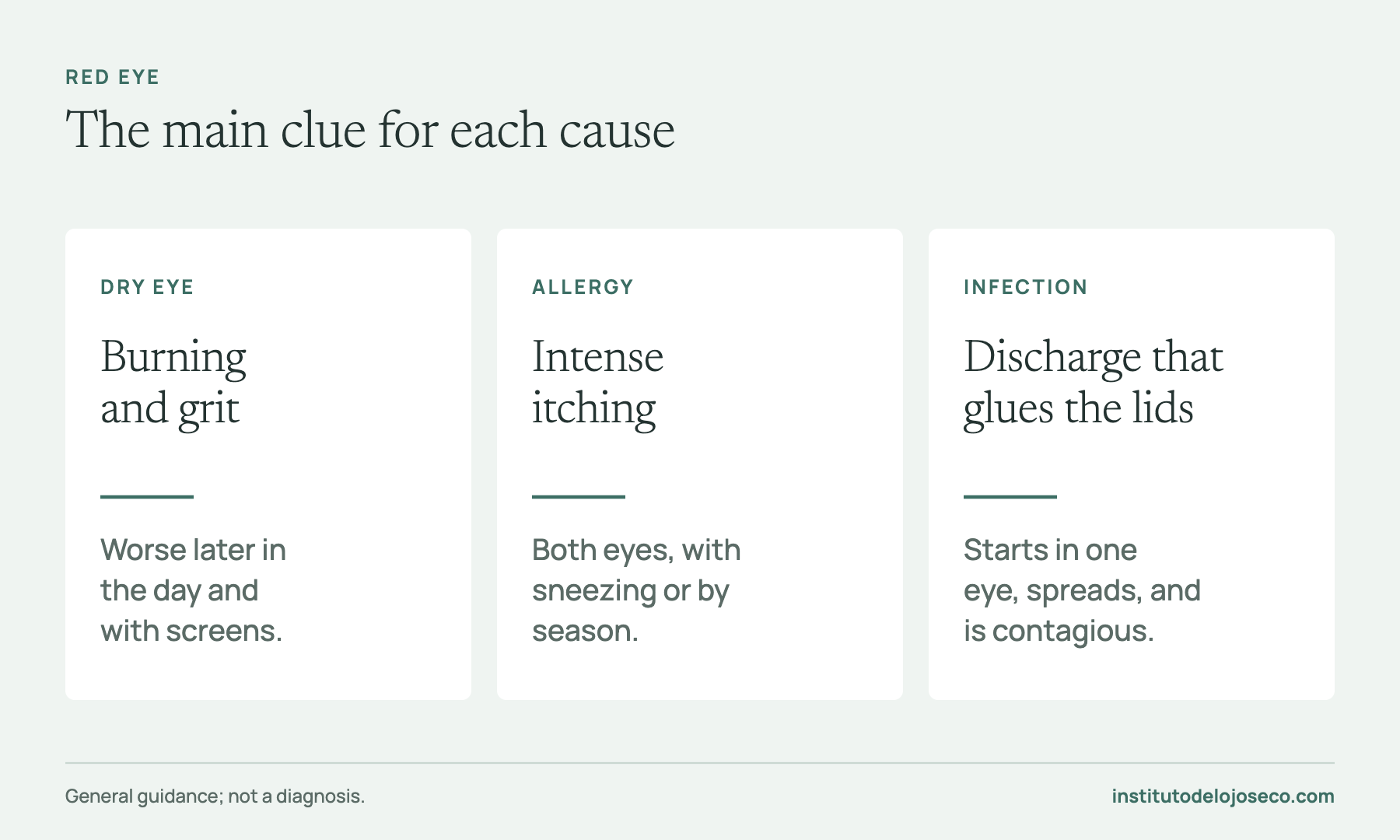
In brief. Burning and grittiness that get worse in the afternoon or in front of a screen: think dry eye.
Intense itching, in both eyes, with sneezing or in certain seasons: think allergy.
Discharge that sticks the eyelashes together, started in one eye and moved to the other: think infection. And if there is severe pain, a drop in vision, or a lot of discomfort with light, it is an emergency.
Why do my eyes burn? The main clue for each cause
Dry eye: burning and grittiness
The tear film breaks up too soon and leaves areas of the surface of the eye unprotected. That feels like burning, dryness, or a foreign body, as if there were sand in your eye. It tends to get worse as the day goes on, with screens, air conditioning, or wind, and to improve for a while when you close your eyes or use artificial tears. It almost always affects both eyes and lasts weeks or months.
Allergy: itching
In allergic conjunctivitis, pollen, dust, dust mites, or pet hair make certain cells in the conjunctiva release histamine. Histamine is what causes the itching, and itching is the most constant sign of allergy. It usually comes with watering, swollen eyelids, and, often, sneezing or a stuffy nose. It affects both eyes and comes and goes with the season or with exposure.
Infection: discharge and contagion
Infectious conjunctivitis is caused by viruses or bacteria. The viral kind is the most common: it usually starts in one eye and moves to the other within a few days, with heavy watering, and it often arrives together with a cold. In the bacterial kind, the discharge is thick and yellowish, and you wake up with your eyelashes stuck together. Both spread through hands, towels, and pillows.
Dry eye, allergy, and pink eye: table of differences
| Clue | Dry eye | Allergy | Infectious conjunctivitis |
|---|---|---|---|
| Main complaint | Burning, gritty sensation | Intense itching | Sticky discharge, foreign body sensation |
| Discharge | Little; sometimes watering | Tears and clear mucus | Watery (viral) or thick and yellow (bacterial) |
| Eyes affected | Both | Both | Starts in one, moves to the other |
| When it gets worse | In the afternoon, with screens and dry air | With pollen, dust, or pets | The first few days |
| How long it lasts | Weeks or months | As long as the exposure lasts | One to three weeks |
| Is it contagious? | No | No | Yes |
Could it be dry eye? Take the dry eye test: 12 questions, 2 minutes, free, with no sign-up. Take the test Or see what the advanced diagnostics at the institute involve.
Why they get confused
Because they can come together. A person with allergies who rubs their eyes irritates the surface and disturbs their tears. The antihistamine pills that relieve allergy also reduce tear production, so it is common to go from itching to burning. And underlying dry eye makes any irritant, such as smoke or pollen, bother you more, because there are fewer tears to dilute it and wash it away.
That is why, when a “red eye” does not quite go away with allergy treatment or comes back again and again, it is worth checking the tears.
What not to do
- “Get the red out” drops. They whiten the eye for a few hours without treating the cause, and with daily use the redness returns.
- Steroid (cortisone) or antibiotic drops on your own. An antibiotic does not work against a virus or against allergy, and a steroid without monitoring can raise the pressure in the eye or worsen certain infections.
- Rubbing your eyes. It brings relief for a few seconds and releases more histamine.
- Wearing contact lenses with a red eye. Take them out until you know what it is.
- Sharing towels, pillows, or makeup if it could be an infection.
When is a red eye an emergency?
Go to an eye emergency service the same day if the red eye comes with:
- severe pain or pain that keeps increasing;
- blurry vision that does not clear when you blink;
- a lot of discomfort with light;
- contact lens wear, especially if there is pain;
- a blow or an injury;
- blisters on the eyelid or on the forehead, or a history of herpes in the eye;
- very heavy discharge with pus;
- recent eye surgery.
None of those signs is typical of dry eye or of allergy.
If a chemical product got into your eye, do not wait: rinse right away with plenty of water for at least 15 minutes and then go to an emergency service.
If it looks like dry eye
If your symptoms are burning or grittiness that have lasted for weeks, come and go throughout the day, and improve for a while with artificial tears, the most likely explanation is that your tear film is unstable. The next step is to measure it, in advanced diagnostics. To get started on your own, read how to choose eye drops for dry eye.
Frequently asked questions
Can I have allergy and dry eye at the same time?
Yes, and it is common. Allergy irritates the surface of the eye, and antihistamine pills reduce your tears. If you treat the allergy and are left with burning, mention it at your appointment.
Does dry eye make your eyes red?
Yes. The irritated surface becomes inflamed and the blood vessels of the conjunctiva dilate, especially at the end of the day. It is a mild, even redness, without thick discharge.
How long does viral conjunctivitis last?
Usually one to three weeks, and it goes away on its own. In the meantime, wash your hands often and do not share towels. If there is pain, a drop in vision, or a lot of discomfort with light, have it checked.
Does conjunctivitis cause itching?
It can cause a little, but when itching is what bothers you most, it is usually allergy. In infection, discharge dominates.
Sources
- Azari AA, Barney NP, Conjunctivitis: a systematic review of diagnosis and treatment. JAMA, 2013. PubMed
- Cheung AY, Choi DS, Ahmad S et al., Conjunctivitis Preferred Practice Pattern. Ophthalmology (American Academy of Ophthalmology), 2024. PubMed
- Wolffsohn JS, Benítez-del-Castillo JM, Loya-Garcia D et al., TFOS DEWS III: Diagnostic Methodology. American Journal of Ophthalmology, 2025. PubMed
- Gomes JAP, Azar DT, Baudouin C et al., TFOS DEWS II iatrogenic report. The Ocular Surface, 2017. PubMed
- Advanced diagnosticsWhat is measured in a dry eye assessment→
- Eye drops for dry eyeHow to choose them at the pharmacy→
This article is general information and does not replace a medical consultation. A table does not make a diagnosis: if you have doubts, have your eyes checked.